
Vance County Schools Innovative School Options – Open House and Registration
The Vance County Schools application process for the innovative school options is now underway, with several options to make sure the district’s students go to the school that fits their needs.
The non-traditional VCS schools are poised to share information with families and students about choosing one of the innovative options that might just work for them.
The innovative schools prospective family nights will be on February 11 from 4:30 p.m. until 6 p.m. at each of the respective schools. February 11 is the new date for all the innovative schools open house events because recent weather forced the original dates to be rescheduled.
VCS Chief Officer of Communication & Innovative Support Aarika Sandlin said, “I strongly encourage our community as a whole to take advantage of the school visits.” They provide an opportunity to not only meet the school principals, but also to see what the school building looks like and feels like – to really understand what the space is about.
“Delve into that,” she said, by going to see it for yourself to make sure this is a fit for your child.
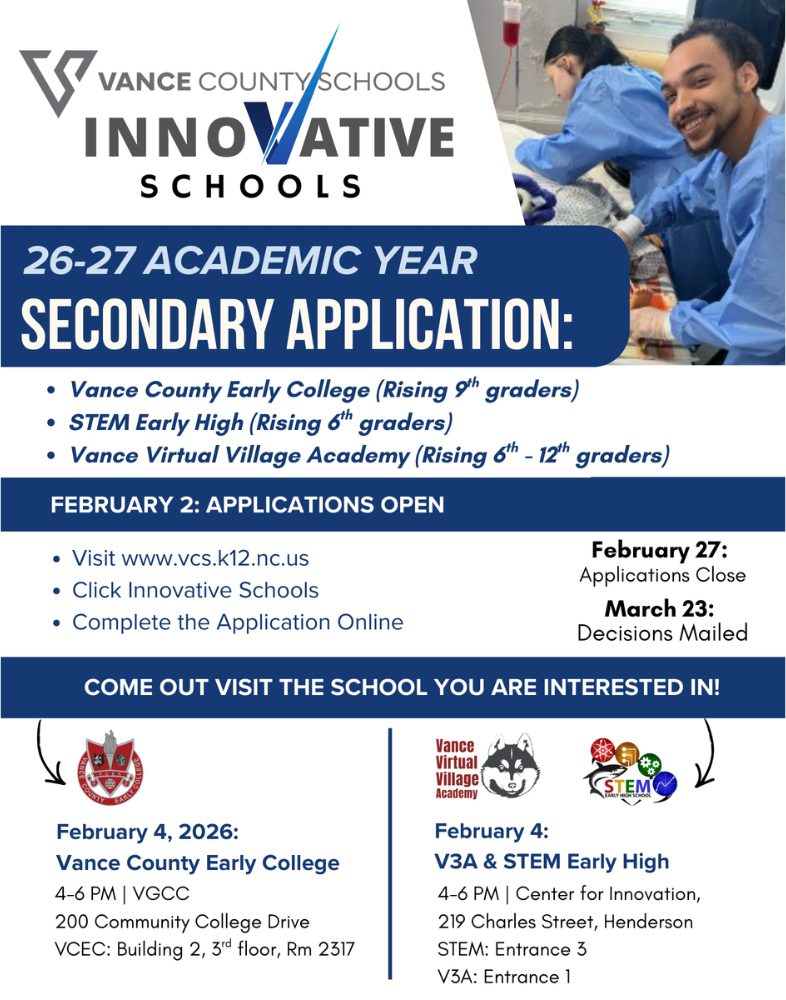
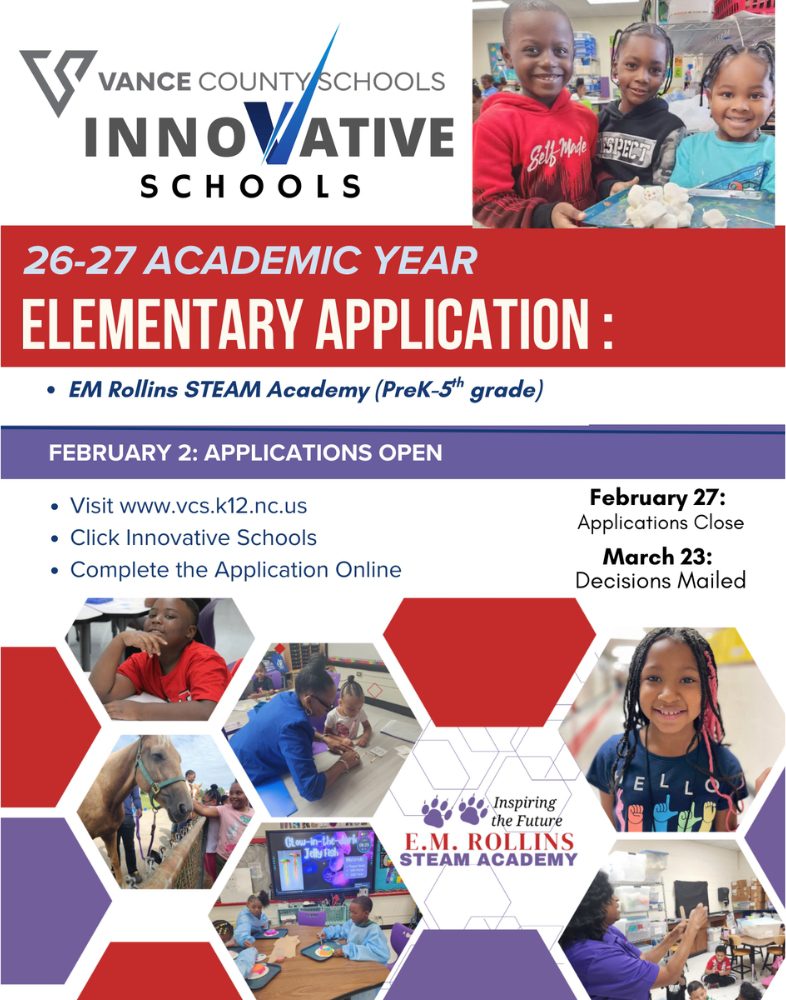
The application period for STEM Early High School, Vance County Early College High School and Vance Virtual Village Academy opened on Monday, Feb. 2 and ends on Friday, Feb. 27. In addition, rising K-5th graders may apply to E.M. Rollins STEAM Academy.
Dr. Destiny Ross-Putney, VCS chief officer of instruction and innovation, said prospective applicants should plan to dedicate a good half hour to filling out the application, because they will be asked about particular courses they’re interested in taking and any special interests they may have.
The application went live on Feb. 2, according to Sandlin. Parents and students can find the application at the VCS website, www.vcs.k12.nc.us.
Each school has videos and other information on their respective websites, and Ross-Putney said that’s a good way to learn more before attending one of the upcoming open house events.
Once the application window has ended, the selection process begins. Decisions will be mailed out by Mar. 23, Sandlin said.
Vance County Early College Interim Principal Dr. Tim Hall encourages parents with rising 9th graders to consider the Early College, located on the campus of Vance-Granville Community College in Henderson.
“Don’t assume that this isn’t for your student,” Hall said. “We’re here to expand access,” Hall said. “The Early College is a life-changing, transformative experience.” Teachers and staff emphasize high expectations but also provide support students need in areas that include time management, study habits, effective communication and self-advocacy.
It’s a place for students who want a smaller high school environment, where they can forge stronger relationships and where they can earn college credits.
Early College students enter at 9th grade and can not only graduate high school but can earn up to two years’ college credit in four-to-five years’ time, depending on the individual student.
STEM Early High is located at the Center for Innovation on Charles Street. The Charles Street location is still often thought of as the old Henderson High School building and the former Henderson Middle School building. STEM Early High principal Jessica Austin said the sixth, seventh and eighth graders who attend this school have the opportunity to earn high school credit before setting foot on a high school campus.
The COGNIA-accredited school provides students access to curricula above their grade level, all in a fun and engaging atmosphere. Regular Club Days allow students to “dig into their passion projects,” Austin said, and expose students to career opportunities that involve Science, Technology, Engineering and Math – STEM.
The middle and high-school students at Vance Virtual Village Academy find an online option best suits their needs, for a variety of reasons. Principal Dr. Jeff Batten said upperclassmen can take classes at Vance-Granville Community also, making college credits accessible to them as well.
Batten said his school has a wide variety of students who, for whatever reason, find a place at V3A. One student travels extensively with his parent. Virtual classes work. Another student wanted to graduate a whole year early and was able to double up on classes to achieve his goal. And there are opportunities for students to come to a physical location to get help a couple of times a week when they need it, Batten said.
Austin said the teachers at STEM Early High offer intentional STEM exposure and accelerated coursework to allow students to get real-world experiences to prepare them for future careers.
“Not all of our students come in ready,” Austin said. “They have gaps, just like all students. We pride ourselves on being able to reach students in our small setting and being able to help them grow.” By the time they finish eighth grade, the gaps are filled and, in some cases, they’re halfway to being a sophomore in high school.
Hall said he is most proud of the transformation he sees among the students at the Early College.
“Students come in unsure of themselves, (and) over time, they become the type of people who can manage college expectations, communicate with instructors, advocate for themselves and lead…this shift is powerful.”
Dr. Carnetta Thomas is the principal of E.M. Rollins STEAM Academy, a modified year-round school. The school serves pre-K through 5th grade with a dynamic focus on science, technology, engineering, arts and math. Thomas said, “Ready to launch your child’s future, E.M. Rollins STEAM Academy is the place where imaginations take flight and excellence is the destination.”
Click Play!


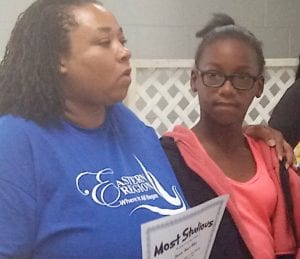 Over the course of three weeks, campers participated in reading and literacy activities, created hands-on math, science and technology projects, and took a Character Education Course designed specifically for middle school students. Campers also participated in several sports and recreation mini-blocks throughout the camp session, including a trip to the movie theater to see animation in action.
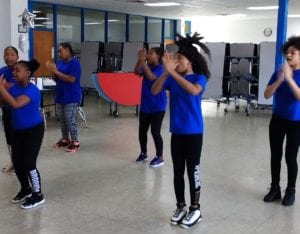 The summer program represents the third segment of a year-long collaboration between Eaton-Johnson Middle School, Henderson Middle School and Triangle Literacy Council. To date, the program has served over 200 middle school students in Vance County and awarded more than $50,000 worth of new computers to students. Most of the students received their new computers in June, following their completion of academic work in the second semester of last school year.