
Tag Archive for: #towntalk

TownTalk 04-07-21 Juvenile Offenders; Gun Violence

What are some of the steps taken in North Carolina when a juvenile is a suspect or person of interest in a crime?

For one thing, it matters if the crime is a felony and if so what letter.  Felonies are grouped by letters, with letter A, for example, being first degree murder.  A felony with a letter of I, for example, might be a drug crime of some sort.  A second thing that matters is has the juvenile been tried and convicted as an adult before – the once an adult, always an adult law (N.C. G.S. 7B-1604).

North Carolina juvenile delinquency law as of Dec. 1, 2019 looks at ages 6-15 as being juveniles for all offenses and ages 16-17 for all non-motor vehicle offenses as being juveniles.  The exception is – any juvenile with a previous criminal conviction, other than a misdemeanor or infraction motor vehicle offense not involving impaired driving, must be processed as an adult.

How the juvenile may be processed when felony charges are involved and he/she is 16 or 17 years old follows a bit of a flow chart as well.  An A-G felony with a finding of probable cause or return of bill of indictment results in a mandatory transfer to superior court.  An H-I felony with a finding of probably cause results in a discretionary transfer to superior court.

The “Raise the Age” Initiative, an NC Legislature-passed law, raised the age of juvenile jurisdiction for nonviolent crimes to age 18 effective December 1, 2019.

In March of 2019, District Attorney Mike Waters told WIZS TownTalk the change would significantly increase the juvenile court workload as the majority of 16 and 17-year-olds, currently tried automatically as adults in NC, will be tried as juveniles when the law goes into effect.

Under the new law, exceptions exist for 16 and 17-year-olds who commit felonies that are classified as A-D – including murder, robbery and burglary – in addition to DWI and other traffic offenses, firearm charges and gang-related offenses.

“North Carolina is one of the last two states in the nation to charge 16-year-olds as adults,” Waters said at the time in 2019. “I want to reassure the public that, under the new law, the DA’s office will have the discretion to prosecute juveniles that commit serious crimes as adults.”

As for the reason behind raising the age limit for juvenile prosecutions, Waters said research and statistics make a compelling case.

“Research shows that many 16 and 17-year-olds that get involved in the court system may not get involved with it again. Tracking someone forever and giving them a record at a young age creates a certain outcome. Also, 16 and 17-year-olds are not thinking the same way that 18, 19 and 21-year-olds are thinking.”

If you follow the suspect, warrant, arrest pattern for adults, those 18 and over, it is just that.  First a suspect with warrant issued for arrest, or arrested on-view with the State as complainant, then appearing before a magistrate and being charged and detained or bonded or released — in the most simple of terms.

Also in broad terms, once a juvenile is taken into custody, then juvenile services comes and a decision is made on whether to transport the juvenile to a secure facility.  The juvenile is granted a probable cause hearing and the decision about being transferred to superior court is made.

For the Wednesday, April 7, 2021 broadcast of TownTalk, hosts John C. Rose and Bill Harris discussed juvenile offenders and gun violence in the local area and nation.

<This is a news article.  This is not legal advice.>

For complete details and audio click play.

 

Kerr Tar Regional Council of Governments

TownTalk 04-01-21 Powerful Tools For Caregivers Classes

Family members who find themselves caring for a loved one – especially those caring for someone with a chronic health condition – often need to find ways to cope with the stress that comes along with the care they give.

A virtual workshop called Powerful Tools for Caregivers, sponsored by the Kerr-Tar Regional Council of Governments, is designed especially to show caregivers how to care for themselves, according to Susan Tucker, evidence-based health care coordinator for Kerr-Tar COG. She and Austin Caton, family caregiver support specialist, spoke with John C. Rose on Thursday’s Town Talk about the workshop and some suggestions and strategies it offers.

The first of the 6-session workshops will be on Tuesday, April 20, from 1 p.m. to 2:30 p.m. A second 6-session workshop begins on Tuesday, May 6, from 10 a.m. to 11:30 a.m. Contact Tucker at 252.436.2040 to learn more or sign up for the class.

It’s different if you’re caring for someone with the flu or a broken leg, which are short-term conditions – there’s an end in sight. The flu will run its course, the broken leg will mend. But someone caring for a family member – unusually unpaid – must deal with extra challenges.

Tucker said the workshop is for “anyone who is providing care for a chronically ill loved one. No matter how that takes shape – whether it’s a child caring for an aging parent or whether it’s a parent caring for their disabled child.” She said many family members often provide unpaid care, and this workshop will offer strategies that support the well-being – physical and mental – of the person who provides the care.

For complete details and audio click play.

Caton said previous participants have appreciated learning techniques to reduce stress and anxiety, as well as learning about how caregiving stresses the body.

“One of the unique things about this program is geared toward the caregiver, but it’s not just a checklist,” he said. Participants receive concrete strategies to implement to “alleviate some of these symptoms, both physically and mentally.”

As a caregiver herself, Tucker said the class was recommended to her. She completed the class and said she was eager to share it with others who found themselves in a similar situation. All caregivers get overwhelmed at one point or another, she said, and that’s when they reach out for help. “Don’t wait until you’re at the end of your rope,” she said. The Powerful Tools class can help prevent that from happening, she said. “It’s not just the what to do, it’s the how to do it.”

Before the COVID-19 pandemic, Caton would visit homes, conduct assessments and provide support to caregivers who had questions about everything from dementia support groups and mobility issues to navigating Medicaid and locating other resources to help the family member being cared for.

But there is little information about just exactly how a caregiver is supposed to take care of himself or herself, Tucker said. This class will guide participants through the process of learning how to provide self-care while being a caregiver to someone else.

“This class is about you, caregivers. It’s not about what you have to do, it’s not about the person you’re caring for, it’s all about you. There aren’t many things out there for us caregivers that feel that way, but this one feels that way because it IS that way,” Tucker said.

TownTalk 03-29-21; Pastor Frank Sossamon Retiring from SHPHC

The Rev. Frank Sossamon knows precisely where he was on the last Sunday of June, 1985. He was preaching his first sermon as pastor of South Henderson Pentecostal Holiness Church. This Sunday – Easter Sunday – he will preach his final sermon as senior pastor to a congregation he has served for almost 36 years.

He may be retiring from the pulpit, but Sossamon is not planning on slowing down any time soon. He reflected on his tenure at South Henderson on Town Talk Monday, and talked with John C. Rose about his plans for the future.

His son John F. Sossamon II runs Sossamon Funeral Home in Henderson and Sossamon said he looked forward to working more with the funeral home, providing services to help families grieving the loss of a loved one, “not just at the time, but throughout the duration of their difficulty,” he said.

Being able to work with his son will be very rewarding, Sossamon said. He said he would be available to offer grief counseling through the funeral home services. “We’re not just in the business of burying the dead,” he said, adding that he wants families to know that they will be supported before, during and after a loved one has died.  “We want to help you through your time of grief and sorrow…help you through a hard and tough situation.”

He and his wife, Vickie, also plan to do some traveling and it was important to him to be able to retire in good health to be able to travel. He’ll be 67 in October, which he admits is “not old, but it’s still retirement age.” He said he’s seen others keep pushing back retirement dates over and over and then not be healthy enough to enjoy their time once they are retired.

Sossamon said it’s also healthy for the church to have new leadership. “It’s a good time…to have a change of leadership after almost 36 years,” he said, “someone else to create vision and direction and move the church to even a higher level of ministry and productivity in the community.”

A new pastor certainly will have big shoes to fill. Sossamon said there already is a pastoral search committee in place to work with the church conference to receive and review resumes of prospective pastors. This committee will interview candidates, then select one to preach a trial sermon, after which the candidate will be introduced to the congregation.

Then comes a vote to determine whether to call the candidate as the new pastor.

Sossamon spent eight years as a pastor in Marion, NC before he came to Henderson. Since his arrival, he has been involved in local activities and the church has presented musical programs which proved to be very popular in the larger community. He said he would be happy to keep a relationship with the church and its new pastor to be engaged and involved however he’s asked.

He said he may always be seen first as a pastor, and that’s ok. “I want to be Frank Sossamon all the time,” he said. He may encounter someone in the grocery store who needs to discuss an issue with him, he said. “I really cannot fully get away from being a pastor and I don’t mind talking to individuals during those times.”

One very rewarding aspect of being a pastor at one church for so long is seeing youngsters grow and develop in their faith and ultimately assume leadership roles in the church, Sossamon said.

The congregation celebrated Sossamon on Sunday during the morning service and again in the evening in a show of appreciation. He said he was glad to be the preacher at Sunday’s service. Easter Sunday “is such a monumental Sunday at the church – at all Christian churches,” Sossaman explained. This year, however, the first Sunday in April will be remembered not only as Easter Sunday, but also the day Sossamon delivered his “farewell” sermon.

TownTalk with Frank Sossamon Broadcast Audio


Town Talk Logo

TownTalk 03-25-21 Covid Vaccinations For First Responders

Thank you for listening to WIZS Radio, Your Community Voice!

Continued discussion about covid vaccine availability to first responders such as EMS, Fire, Police, Deputies and Highway Patrol.

TownTalk Broadcast for 3-25-21.

H-V Chamber Logo

TownTalk 03-23-21: H-V Chamber Advances will help with Human Resources

The newly formed Human Resources Council, a program of the Henderson-Vance Chamber of Commerce, will have its first meeting on Thursday, Mar. 25 at 1 p.m. There’s still time to register to participate in the virtual meeting, according to Chamber President Michele Burgess.

Burgess said the council, which falls under the chamber’s business growth and development division, will bring together human resources professionals from a variety of businesses and industry to network, problem-solve and share ideas. The council will meet monthly, she said, and will feature guest speakers.

The purpose of the council is “to help our members grow and to help them solve problems that they’re losing sleep over at night,” Burgess told John C. Rose on Tuesday’s Town Talk. Until the group can gather in person again – which Burgess hopes it will be able to do by the fall – virtual meetings can help connect area human resources professionals to one another. And this, she said, will build relationships as well as a network for sharing ideas and helping solve HR problems.

One of the challenges that businesses, both large and small, face in the Vance County area is finding employees to fill job openings, Burgess said. These days, besides asking for information about COVID-19 related loans and grants, the Chamber fields calls from companies wondering how and where to find good employees. “That’s really how the whole human resources council came to be,” she said. “It really started even before COVID,” she said, adding that she hopes through strengthening relationships with the public school system and VGCC, the talent pool and workforce development can improve for area business and industry.

Thursday’s speaker is Cherrelle Lawrence, dean of corporate learning and professional development at Vance-Granville Community College. The topic is “Investing in Talent.” Lawrence, who also serves as dean of VGCC’s Franklin campus, will kick off the council gathering with an overview of topics related to human resources. “I’m excited for my business members to hear her,” Burgess said. “She is really dynamic and full of energy!”

TownTalk Podcast with Michele Burgess.

The HR Council will serve to inform human resource officers and managers in local businesses about innovative programs including specific training, apprenticeships and internships offered in the community, she said. “We like being involved,” Burgess said of the Chamber, “but we also like to share with our other partners like VGCC’s Small Business Center, local economic development commission and other entities that attract new business.

“We feel like the workforce issue is very important at this particular time,” Burgess continued. “We want to keep our local businesses here and operating (and) workforce pool is key to that,” she said. “We realize (at the Chamber) that we can’t do everything. But getting people employed and helping our industry” is a top priority.

The Chamber’s business growth and development division is co-chaired Chamber members by Brian Williams, account manager at Temperature Control Solutions, and Stephanie Hoyle, broker associate with Century 21 Country Knolls Realty.

To learn more or to register for the Thursday meeting, email michele@hendersonvance.org or call 252.438.8414.

TownTalk 03-22-21 William Landis, Small Farms Week

Small farmers make up about 80 percent of farmers in this area and provide the community with delicious produce and pasture-raised meats that consumers can find at local farmers’ markets. But small-scale farmers are not necessarily trying to compete with, or become, large-scale farmers, according to William Landis with Franklin County Extension Service.  He told John C. Rose on Monday’s Town Talk that small farmers who can find a niche product or a niche market can position themselves to be successful.

Landis is the small farms agent for Franklin and Warren counties. Part of his job is to help small farmers with resources to become as efficient and productive as possible. These days, with so much information available via the internet, it may be challenging for producers to make choices about how and what to grow on their farms.

“Come to us,” Landis said of cooperative extension services. “Bounce what you’ve heard off your local extension agent. We’re here to help you out,” he said. Many small farmers around here, he said, have full-time jobs off the farm and do their farm work when they get off work.

March 21-27 is Small Farms Week in North Carolina, thanks to the Cooperative Extension program at N.C. A&T State University. And a Franklin County farmer is in the running for Small Farmer of the Year.

Mike and Suzanne Jones run MAE Farm and they market their pasture-raised meats at the State Farmers Market. Jones has been a farmer since the early 2000’s, long before Landis became an extension agent. “It’s good to see that he’s finally getting recognized,” he said.

The winner will be announced on Mar. 24 during the virtual Small Farms conference.

Small Farms Week TownTalk Podcast

Selection criteria include how small farmers are engaged in the community, as well as innovative practices that are used on the farm, Landis said. Jones is involved with the local Farm Bureau and uses innovative pasture management practices like silvopasture – letting animals graze in forested areas – and rotational grazing of multiple species.

Landis said a small farm is one that has less than $250,000 a year in income. Advances in technology, from tractors with built-in GPS systems to the use of drones, have been helpful additions for producers. Other types of technology – like phone apps – are also being used to help boost the agritourism industry, Landis said. One such app is called Visit NC Farms. Producers load information about their farm and it’s accessible via the app. Agritourism is a growing trend and has helped small farmers weather the COVID-19 pandemic. Other online tools like MeatSuite can help consumers find locally sourced meats in their area, he added.

Franklin County, he said, is situated in a perfect spot to respond to the huge Raleigh-Durham market. “Within 30 minutes, you can be in Raleigh and deliver your product,” he said. The Raleigh-Durham market is one of the largest markets in the U.S., he said. Responding to the needs and wants of a market that size is what can put a small farmer on the road to success.

Right now, the Franklin County Farmers Market is located near the Carly C’s on Bickett Boulevard in Louisburg. It currently operates under a shelter on Fridays from 9 to noon, but Landis said there is some movement afoot to create a closed-in market.

TownTalk 03-18-21: Vance County Comprehensive Architectural Survey to be Conducted

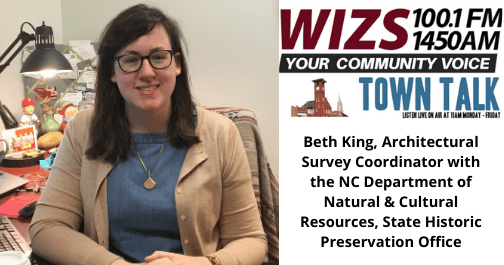
Local history buffs, take note: Vance County is one of six counties chosen to have a comprehensive architectural survey conducted over the next couple of years. A state historic preservation expert was on Town Talk Thursday to discuss the project with Bill Harris and Mark Pace.

Elizabeth King, architectural survey coordinator with the NC Department of Cultural Resources, said the next step – after selecting field workers – will be to have a “scoping phase” which could start as early as this summer. This phase should take about six months and includes examining the 300-plus properties already identified in Vance County, most of which are in Henderson. The second phase involves conducting a complete evaluation of rural Vance County, including Kittrell and Middleburg, she said. Then the final phase, which should start in early 2023, will take a thorough look at yet-to-be-identified properties in Henderson.

King said this project is “long, long overdue” for Vance County.  The project is scheduled to be completed by late 2023.

The most recent architectural survey was conducted in 1974 and was meant to be merely an information-gathering project rather than a comprehensive record of buildings and places with historical significance, she said.

Back in 1966, Congress passed the National Historic Preservation Act, whose mission was to create a national inventory of historic buildings and historic places, King noted.

As coordinator of the survey in her role with the State Historic Preservation Office, she said she is “standing on the shoulders of giants” because North Carolina is recognized for having one of the best architectural survey programs in the nation.

Click play for 3-18-21 TownTalk broadcast.

In the early 1970’s, young people, many fresh out of college, were hired to do a county-by-county inventory of historic buildings, King said. They interviewed residents in the communities and created a record of historic places that were beginning to disappear from the landscape and from people’s memories.  “These young surveyors were going out and capturing local history from some of the last people who were living that agrarian lifestyle,” she said of the work done back then.

The migration from rural to city life after World War II, as well as the creation of Kerr Lake in the 1950’s are a couple of factors that contribute to fading memories and disappearing buildings that could be considered architecturally and historically significant.

King said she and her colleagues in the historical preservation field use “the 50-year rule” when talking about historical significance of buildings and places. This year, a building built in 1971 could be considered as having historical significance, she explained. “But it may not be ‘historic’ with a Capital H,” she said. “We have to continually be moving that needle to be capturing younger aspects of our history,” King added.

What makes or breaks projects such as the survey is local involvement, King said. “We want to raise awareness at a local level of what is special and regionally unique” to the area, she said. A public meeting will be held closer to the beginning of the field work phase to exchange information with the community. King said the project will certainly have a technical component to collect information such as window patterns, roof lines and the like, but another component is “to listen and absorb” information from the community.

And rest assured, she said, that nobody associated with the survey will visit a property without permission. “We do not trespass. If we aren’t invited on someone’s property, we will attempt to make contact,” she said, adding that all workers would be clearly identified and will carry business cards and official letters stating the purpose of their visit.

To learn more, contact King at elizabeth.king@ncdcr.gov or 919.814.6580.

TownTalk 03-16-2021; Angela Allen, Granville Co. Tourism March and Spring Events

TownTalk guest Angela Allen, Granville Co. tourism director, described multiple events starting this week and weekend and into the spring.

With spring and Easter in the air and more and more people wanting to get out of the house, Allen listed off events for children and adults, including the upcoming bridal tour which still has availability.  Four venues will be featured, with tours included.  Granville Brides on Wheels on Eventbrite will get you signed up or visit www.brides-on-wheels.com.

Check out the Cedar Creek Gallery Glass Egg Fundraiser March 16 to March 26 in Creedmoor.  All proceeds go to the Food Bank of Central and Eastern North Carolina.  There are prizes including raffles for 55 blown glass eggs and the event is available online as well.

The Spring Fling Maker’s Market Food Truck Rodeo happens this weekend on Saturday (March 20th) from 11 a.m. until 3 p.m. in Oxford.

An inaugural Children’s Easter Egg Hunt will take place Saturday (March 20th) at Vino Oasi in Stem.

Carlee Farm presents the Spring Marketplace Sunday in Oxford.

A full listing of events in Granville County can be seen online at https://visitgranvillenc.com/whats-happening/.

For complete details and audio of Angela Allen click play.

(Granville Tourism is a paying advertising client of WIZS. This text, radio show and resulting podcast is not a paid ad.)

TownTalk 03-15-21; NC 811 Exec Dir Louis Panzer; plus Vance Co. Fire Reorganization

Whether you’re planting a few shrubs around the house, putting in a new mailbox at the driveway or starting some larger project around the yard, the first step should be dialing 811 to make sure where you dig is free of underground pipes or wiring.

Louis Panzer, executive director of North Carolina 811, Inc. told John C. Rose on Monday’s Town Talk that state law requires that homeowners and contractors alike call the agency before the first shovelful of dirt is moved.

The “Call Before You Dig” messaging campaign has been seen on billboards and other spots for about 10 years, and Panzer said the message has had a positive impact in the state.

“I’d say it has some traction,” he said. “It’s a pretty simple message we want to convey,” Panzer added.

With spring around the corner and warmer weather inviting homeowners to begin outdoor projects, Panzer said projects that require digging should always begin with a call to 811. April is Safe Digging Month, so remember to follow the process of calling 811 before you dig. According to NC 811, every nine minutes an underground utility line is damaged because someone decided to dig without first calling 811 to learn the approximate location of underground utility lines.

“We do ask that folks take the time to notify us,” Panzer said. There may be easements or rights-of-way that contain underground utilities. “It’s the sensible thing to do to take the time to notify us,” he stressed. When the call is placed, Panzer said homeowners should provide as much detail as possible about the project and should expect to have a three-business-day wait period. This gives 811 staff time to communicate with utilities providers to come out to the property to mark where their lines are located. The caller will be informed about which utilities will be responding, then a follow-up email when the markings have been completed, Panzer said.

Mondays are always the busiest day for 811, he said, adding that in one day – a Monday – they logged 10,800 calls. Last year, the North Carolina 811 received more than 2 million requests for help locating underground lines.

Utilities will come in and mark their lines free of charge, but for private facilities there is a charge. Visit nc811.org to find a list of private line locators.

The call center is strict about the three-day wait period. There is an “emergency ticket” process, but that is reserved for cases where there is a “threat to life, health and property,” he said. Poor planning and time management don’t count. Homeowners can call up to 12 days before they intend to dig, according to information on the website.

Underground lines and pipes provide phone and internet service to homes and businesses, as well as essential services like water and gas. Calls to 811 can prevent damage to lines and costly repairs.

Gas lines are monitored and regulated by the U.S. Department of Transportation, Panzer noted, and said that pipes are a very safe way to move the product. “As long as (the gas) is in there,” he said, it’s super safe.” Something as simple as a cut or a scratch in a gas line can create a weak point in the pipe that can cause problems in the future, he warned.

Any contact with a gas line should be reported immediately to the gas company. It also is a state requirement that any damage – even a nick or scrape – be reported to North Carolina 811. Of course, if there is a “product release” such as a release of gas, “your first call is 911,” Panzer said.

The 811 website says that the markings made by the utility companies are valid for up to 15 days. Try to avoid digging on top of or within 18-24 inches on all sides of the marks. This could mean moving your project to another site to a spot with fewer buried lines.

For complete details and audio click play.