Tag Archive for: #nwsraleigh

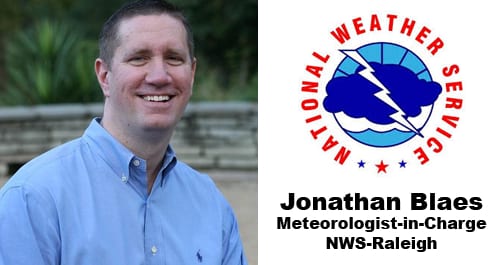
National Weather Service

During Severe Weather Preparedness Week, Governor Stein Reminds North Carolinians about Readiness Tips

March 1-7 Is Severe Weather Preparedness Week

During Severe Weather Preparedness Week, Governor Josh Stein is joining emergency management officials in urging North Carolinians to be prepared should severe weather impact their communities.

“North Carolina is no stranger to severe weather that can strike anywhere in the state,” said Governor Josh Stein. “North Carolinians can get prepared now by updating their emergency kits, having preparedness plans, and staying informed. Visit readync.gov to learn more.”

Governor Stein is also encouraging North Carolinians to participate in this year’s statewide tornado drill on Wednesday, March 4, at 9:30 a.m. by going to the lowest floor of the building they’re in and finding the most interior room. Knowing the location of the safe place at home or at work is essential for withstanding severe weather. Tornadoes form during severe thunderstorms when winds change direction and increase in speed. These storms can produce large hail and damaging winds that can reach 300 miles per hour.

In addition to Governor Stein, the National Weather Service indicates online at weather.gov/rah/severeprep, “This week is North Carolina’s annual Severe Weather Preparedness Week. This week the National Weather Service and the North Carolina Department of Public Safety are teaming up to bring this severe weather safety campaign to all of North Carolina’s residents. With warmer weather quickly approaching, now is the time to prepare for the severe weather season. If each North Carolina resident would take a few moments this week to learn about severe weather safety and implement a safety plan, then we would all be better off when severe thunderstorms and tornadoes inevitably strike our state and the likelihood of injury and fatalities caused by severe weather could be minimized.”

“A tornado can develop rapidly with little warning, which is why we encourage families, businesses, and individuals to have plans in place so they can respond quickly to a tornado and get to safety,” said Will Ray, Director of North Carolina Emergency Management. “We encourage all North Carolinians to participate in the statewide tornado drill to ensure that you, your family, and your coworkers know where to go and what to do in the event a tornado or other severe weather impacts you.”

Test messages will be broadcast via the Emergency Alert System on radio and TV and on National Oceanic and Atmospheric Administration (NOAA) weather radios when the drill begins.

The NWS states, “On Wednesday, March 4th at 9:30 AM, the National Weather Service in cooperation with local broadcasters will conduct a statewide tornado drill. The alarm test, which will come in the form of a Required Monthly Test, will activate the State Emergency Alert System and be carried by local radio broadcasters. Every school, business, and residence is encouraged to participate in this drill. It’s really easy: at 9:30 AM on Wednesday, take a few moments to practice your severe weather safety plan, and seek shelter for a few minutes as if a tornado was headed your way. Practicing this when the weather is good will allow you to react more quickly when the weather turns bad.”

Across the state in 2025, North Carolina recorded 16 tornado touchdowns, 113 large-hail events, 710 damaging thunderstorm wind events, and 216 flood or flash flood events.

Emergency Management officials recommend the following safety tips:

  • Develop a family emergency plan so each member knows what to do, where to go, and who to call during an emergency.
  • If thunder roars, go indoors! Lightning is close enough to strike you.
  • Know the location of the nearest safe room, such as a basement or interior room away from windows.
  • Know the terms: WATCH means severe weather is possible. WARNING means severe weather is occurring; take shelter immediately.
  • Assemble an emergency supply kit for use at home or in your vehicle. Make sure to include a 3-day supply of non-perishable food, essential medication, and bottled water for each person and pet.
  • If driving, leave your vehicle immediately to seek shelter in a safe structure. Do not try to outrun a tornado in your vehicle, and do not stop under an overpass or bridge.
  • If there is no shelter available, take cover in a low-lying flat area.

To learn more about how you, your family, or your business can become more resilient and prepared for all hazards, visit readync.gov.

(Information courtesy of the National Weather Service, the State of North Carolina and the Office of Gov. Josh Stein.)

Click Play To Listen To This Story
Microclimates, Hot Weather, Thunderstorms, Hurricanes and Forecasting

They probably don’t teach terms like “crazy hot” in meteorology school, but everyone around here knows firsthand exactly what Jonathan Blaes means when he says those words to describe this summer’s weather.

Blaes, director of the National Weather Service office in Raleigh, summarized the current weather pattern that has sent temps soaring into the triple-digit range across parts of the Midwest and West.

“In Texas and Arizona, it’s been crazy hot without a break for months,” Blaes said on Tuesday’s TownTalk.

North Carolina summers often see stretches of hot weather for days in a row, but not months. “This (pattern) has been pretty persistent and pretty remarkable,” he added.

The thunderstorms that blew through the area earlier this afternoon are ushering in a slight break in the heat and humidity, with predicted highs hovering in the mid- to upper 80’s for the rest of the week.

Heat and humidity are the basic fuel for thunderstorms, Blaes said, so why don’t we have thunderstorms every single day during the summer?

We feel the heat and humidity down here on the ground, but there are other factors that affect the likelihood that afternoon storms will pop up, he explained. Take the temperature of the air at higher elevations, from cloud level and beyond, for example.

Temperatures need to cool off at a steeper rate to fuel storms, so when it’s “hot all the way up into the clouds,” that cooling doesn’t always occur at the rate needed to create storms.

But there are other factors closer to earth that have a bearing on the weather, including soil makeup, elevation and bodies of water, just to name a few.

“Weather is very local,” he said. “Details matter. Locations matter,” he added. “All those different features and materials interact with the air and sunlight and they’re different.” Those differences help to drive the weather patterns in a particular area, both in the short-term and long-term.

And Blaes and his team consider all those factors when they make their forecasts.

The National Weather Service team is keeping an eye out as hurricane season continues. There already have been four named storms, and we’re barely three months in, he said.

The NOAA forecast is calling for above normal activity this hurricane season, with between 14 and 21 named storms.

Typically, we can count on 14 named storms. Of that number half, will become hurricanes. Of that seven, half of those will be Category 3 or stronger, Blaes said.

“Things are going to ramp up and you can place a pretty good wager we’re going to be hearing more about tropical storms in the Atlantic,” he said.

Thanks to sophisticated technology advances, forecasts are more data-driven and less prediction or educated guesses.

In the event of a hurricane between now and November, Blaes said one thing he’d for sure recommend is to prepare a hurricane kit and make a plan. Just in case.


CLICK PLAY! 

TownTalk: NWS Predicts Above Average Hurricane Season

Summer’s On The Doorstep And That Means Hurricane Season Is, Too

Summer is still officially about a week away, but Jonathan Blaes, meteorologist-in-charge at the National Weather Service office in Raleigh says it’s not too soon to be thinking about having a plan in case of a hurricane.

Blaes said Tuesday that the first two named storms have posed no threat to North Carolina, but the June to November hurricane season is shaping up to be another busy one for weather forecasters. And he’s watching another system in the Gulf of Mexico that could bring our area rain in the next three to five days.

“This season is likely to be another busy one,” he said. He said last year was an extreme year, and this year is shaping up along the same lines.

He told Bill Harris and John C. Rose on Town Talk that this is the seventh consecutive year that a tropical storm has developed before the normal June start date. There’s even talk about changing the official start date to May 15 because of this, he said. “The weather doesn’t really know the calendar very well – that’s for people to worry about,” Blaes said.

TownTalk Broadcast with Jonathan Blaes

Meteorologists must deal with more and more data in their jobs, and artificial intelligence is one tool that helps target more meaningful data to make their forecasts. But Blaes said it’s important to know when to rely on computer models. “There are certain patterns where humans add a great deal of value to forecast,” he said. One example is cold air damming or “the wedge.”

In winter, when temperatures hover in the 30s and 40s for days, “the wedge” sits over the area and computer models struggle with just how long the weather pattern will last. “Sometimes, we (humans) can beat the models,” Blaes said. But at other times, such as accurately predicting the track a hurricane will take, it’s best to leave it to computers.

“Weather likes balance,” Blaes said, “and to be honest, that’s what a hurricane does.” Hurricanes are nature’s way to remove excess moisture and heat from one area of the globe and put it somewhere else – the Atlantic Ocean supports development of a Bermuda high pressure system, which “hurricanes tend not to be able to drive through,” Blaes said.

Depending on where that high is set up that often will dictate the path a hurricane takes, he added.

“There’s a reason we have a rich history in this area,” he added. Hurricanes oftentimes graze us, and sometimes crush us.”

TownTalk for Snow Lovers, Weather Buffs and Scientists

There really IS a chance of snow on Friday, according to a meteorologist with the National Weather Service. While there could be some accumulation in our area, the term Jonathan Blaes used to describe what we could see probably isn’t used much at his office in Raleigh  – it’s going to be wet and gloppy.

Blaes is the meteorologist in charge for the National Oceanic and Atmospheric Administration (NOAA) National Weather Service in Raleigh. “The rumor, the conjecture, the excitement is already out there,” Blaes told Town Talk host Bill Harris on Tuesday. He said there may be just enough cold temps associated with the system to create some wet snow, “and some of that will likely accumulate in some spots.”

But he doesn’t predict icy conditions and freezing rain or sleet, more a period of rain that mixes with wet snow, falling heavily, at times. And snow lovers, stay tuned: weather patterns and the jet stream flow the NWS is watching now could make you “optimistic” during the second and third weeks of January.

In addition to getting snow lovers’ hopes up, Blaes discussed weather topics and trends and how they affect North Carolina, from hurricanes and El Niño to why Person County seems to get more snow than its neighbors to the east. And why it’s been so awfully wet here lately.

Click play for TownTalk with guest Jonathan Blaes…

Blaes returned to Raleigh in 1998 (after stints in Sterling, VA and Albany, NY with the National Weather Service) and most recently as science operations officer at NWS in Raleigh, working to promote science and training while facilitating collaborating research activities with the University and other partners. He is a 1995 graduate of NC State, where he received a degree in meteorology from the Marine, Earth and Atmospheric Sciences Department.

“It has been rainy… in the northern Piedmont,” said Blaes, confirming the excessive rainfalls lately. This past year was one of the top 5 – 3rd or 4th wettest year on record,” and that’s without major impact from hurricanes. What began last winter and continued through spring is likely to remain in place this coming spring, he said.

Every 10 years, NOAA releases a 10-year trend for weather. He said the next update likely will present a set of data that shows slightly warmer temperatures on average. That doesn’t necessarily mean that temperatures are rising, he said, but that nighttime temperatures aren’t quite as low, which would push the overall average a bit higher.

All this may contribute to fewer big winter ice storms in the area, but climate outlooks overall can be a little tricky, Blaes said. Precipitation forecasts are more straightforward –check “how much rain is in the gauge every day and add it up,” he said. “All it takes is one big storm” to skew the overall weather trend and to make it memorable.

This past year was a memorable hurricane season, Blaes said. The hurricane “season” traditionally runs June through November, but weather experts now are looking at storms forming in May. Reluctant to tie it all to climate change, Blaes said the systems that we in North America see as hurricanes form in sub-Saharan Africa, travel over the warm waters of the Atlantic and gain strength before doing damage as a hurricane in the Caribbean and the U.S. In general, climate change could mean not more storms, but storms that bring more rain. Higher rainfall in Africa can affect the storms we see here.

“Keep in mind, while we didn’t get clobbered by a hurricane this year, we didn’t have a landfall of a strong tropical storm or a hurricane that devastated the coast, we actually had the remnants or the fringes of anywhere between six and eight tropical storms or hurricanes impact our state,” Blaes said. And while we didn’t have a direct hit, the “glancing blows” from fringes of storms had an impact. Some of the worst conditions, he recalled, were recorded in practically the middle of the state – Greensboro – as the remnants of a hurricane made its way from Louisiana across the NC mountains. Nearly half of the rainfall from late July through September is the result of a tropical storm or its remnants.

Stronger, wetter storms that track farther inland, as well as sea level rise, Blaes said are warning signs that people should be aware of.  Because North Carolina is situated in the middle latitudes, we get systems from the tropics as well as Arctic air from the Poles. The mountains to the west between the mountains and the ocean, our state experiences strange weather from time to time. The mountains to the West and the warm waters of the Atlantic Ocean both affect weather systems and patterns. “We’re in this mixing bowl,” Blaes noted. Mother Nature is always looking for balance. If there’s too many of one thing or if it’s too hot or too cold, Nature wants to find a way to get things even. But it never succeeds. That imbalance, that effort to achieve balance is what causes the weather,” he said.