Items to Buy and Sell

CLICK HERE TO EMAIL US YOUR ITEMS

100.1 FM ~ 1450 AM ~ WIZS ~ YOUR COMMUNITY VOICE

•••••••••••••••••••••••••••••••••••••••••••••••••

Tuesday, March 3

  • Looking to buy a 55 gallon metal barrel. Contact (252) 492-0289 or mobilemoe@yahoo.com

Wednesday, February 25

  • A 42 inch craftsman zero turn lawn mower. Asking $700. Needs a battery. Does run. Contact (252) 432-5195 or charlesreavis73@gmail.com

Monday, February 23

  • For Sale: large glass and wood display cabinets, asking $35.00 each. Size: 57 inches long, 40 inches tall and 25 inches deep. Several cabinets available. Contact (252) 432-9236 or oaktree@centurylink.net for more information

Monday, February 16

  • A nice full size bedroom suite, asking $200. Stock Toyota tires and rims, asking $100. Contact (252) 432-4187 or robersoncharles1965@gmail.com

(Once we are notified of a change to or sell of an item or the item has been posted for more than two weeks, WIZS removes the item from this page and the on-air listing.)

TownTalk: Around Old Granville – Black History in Old Granville County

By the end of the American Revolution, the population of what was then known as Granville County was about 8,000 people. Of that number, 40 percent – or 3,200 – were enslaved.

The plantation system created by wealthy landowners was utterly dependent on that labor to get in tobacco and other crops.

But mostly, it was tobacco, said Mark Pace, local historian and North Carolina Room specialist at the Richard Thornton Library in Oxford.

In their tri-weekly discussion Around Old Granville, Pace and WIZS’s Bill Harris reviewed the lives of numerous prominent Black Americans who made a mark in their communities and beyond.

Up until the time of the Civil War, farms were getting bigger and bigger so owners could produce more and more tobacco. That meant the number of enslaved people grew, too. This was a common practice particularly in the northern parts of present-day Vance, Granville and Warren counties, Pace said.

But there also were many free African Americans living in the area before 1865, Pace said. He attributes that to this area’s proximity to the Virginia border. Virginia had passed a law in 1807 that said emancipated persons had one year to leave the state or risk being re-enslaved

“They didn’t want a lot of free blacks,” Pace said of the folks in Virginia, “so a bunch just came across the line.”

Some enslaved people planted crops on land given to them by their owners. They’d work on Sundays – their only day off – to tend their crops. Some planted tobacco, and over time, they saved up enough money to buy their freedom, Pace explained. Until Granville County passed a law in 1800 banning the practice.

One of the most prominent and well-known Blacks in the late 1700’s and early 1800’s was John Chavis. Born in Virginia to parents who were free Blacks, Chavis graduated from Princeton and Washington & Lee University and became a Presbyterian minister and a noted tutor to many children of wealthy White families.

“He was a brilliant guy,” Pace said. “He was very urbane, he was well read, knew the Greek classics. He had a lot in common with prominent wealthy landowners and by all accounts, was an excellent speaker.”

The Presbyterian Church was dedicated to the idea of improving the lives of black people, particularly those who lived in the pre-Civil War South. As a Presbyterian minister, Chavis was a key player in that mission.

Other prominent men included Henry Plummer Cheatham, James Hunter Young and George Clayton Shaw, all born between 1857 and 1863. Cheatham and Young both had white fathers. They became state legislators and their rise to prominence was well known.

Shaw, meanwhile, established Mary Potter Academy in Oxford in 1889 to educate African Americans. He was the principal until 1936. The school later became a private boarding school until the 1950’s when it became a public high school and later a middle school.

At about the same time that Shaw was establishing Mary Potter Academy in Oxford, there were similar efforts in Vance County as Henderson Institute and Kittrell College were being established.

“In the 1880’s, education is starting to become important,” Pace said, and it’s where many local African Americans made their mark.

Founded and operated by the United Presbyterian Church, Henderson Institute was originally established by the Freedmen’s Board. It was a four-year school – the only high school in this part of the state for African Americans, Pace noted.

John Adams Cotton led the school for 30 years. He was a Presbyterian minister and the namesake of Cotton Memorial Presbyterian Church in Henderson.

“The school stayed in business in one form or another until 1971,” Pace said.

The N.C. Conference of the African Methodist Episcopal Church established Kittrell Junior College in 1885-86. The two-year school was housed in the old hotel building in Kittrell for the first few years before James B. Duke dismantled numerous buildings on the Trinity campus and sold the bricks to the Kittrell school as he made space for what would become Duke University.

Warren County native John R. Hawkins was a driving force behind Kittrell College, Pace said. Hawkins joined the faculty and later was elected president of the school.

“People from all over the world came to Kittrell College.”

Now the site of the Kittrell Job Corps, the campus had a series of fires in the early 1970’s that destroyed those structures that had their beginnings in Durham.

CLICK PLAY!

Photo Search: Armed Forces Members Killed In Action Since Formation Of Vance County

Originally posted TUESDAY, JAN. 20, 2026

A subcommittee of Vance County’s America 250 group is in the process of collecting photos and information for the 124 individuals who hailed from Vance County and were killed in action in service to their country.

The plan is to have banners placed throughout the downtown area by Memorial Day this year. So far, everything is going along on schedule, but the committee is enlisting the help of the community as it continues to search for photos of the fallen heroes.

To date, 58 photos have been obtained, leaving 66 yet to be located. Each banner will feature the name and photo of the individual, as well as a QR code to learn more information about each person.

Barbara Harrison, who serves as chair of the county’s America 250 committee, also is heading up the subcommittee to find photos of those killed in action.

The America 250 committee is working with the Vance County Historical Society, Perry Memorial Library and others to get the word out about the banners and the photo search.

Below you can access the names of the men from Vance County who were killed in action since the county was established in 1881.

There are 10 names that remain under review to confirm that they were from Vance County, Tem Blackburn said, president of the Vance County Historical Society. Those names under review leaves a possibility that the final list could grow to as many as 134.

The banners will have a QR code on them, that, when scanned, a viewer will gain access to additional information about the individual. The library is the hosting website for the information that the QR code will access.

Blackburn expressed thanks to Patty McAnally and Monica Alston at Perry Memorial Library for their help with the project.

Visit https://www.perrylibrary.org/home and click on the tab ‘America’s 250’ to see the full list, or scroll down in this post.

He said that Tracy Madigan will coordinate with city employees to make sure the QR code on the installed banners can be accessed from street level.

“She going to investigate and do a test run,” Blackburn explained.

••••••••••••••••••••••••

Originally posted MONDAY, JAN. 19, 2026; Submitted by Tem Blackburn, President, Vance County Historical Society

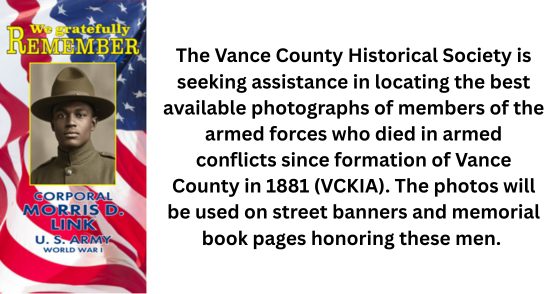
The Vance County Historical Society is seeking assistance in locating the best available photographs of members of the armed forces who died in armed conflicts since formation of Vance County in 1881 (VCKIA). The photos will be used on street banners and memorial book pages honoring these men.

The street banners will be deployed beginning on Memorial Day 2026 and each year thereafter on Memorial Day. The Memorial Book will be on permanent display at the entrance to the Society’s Historical Museum on the second floor of Perry Memorial Library. A QR code on each banner will link to the Memorial Book page for the VCKIA service member shown on the banner.

The street banners and memorial book initiatives are joint projects of Vance County Historical Society, the Vance County Committee for America’s 250th anniversary celebration and Perry Memorial Library. Both initiatives are being funded by the John William Pope Foundation.

A joint committee of VCHS, VCA250, and PML, chaired by Barbara Harrison, is conducting the photograph search. She also Chairs the Vance A250 Committee and is Regent of the John Penn Chapter of the Daughters of the American Revolution. In announcing the search, Mrs. Harrison said: “We are all excited about this project to honor the sacrifice of local service members since Vance County was formed in 1881. The memorial pages will present information that, in many cases, has not been known about their service and sacrifice, even to family members. The death notices and obituaries frequently provided no more information than the statement that the fallen warrior died ‘in France’ or ‘at sea.’ We now have access to a great deal more information about the specific locations, battles and conditions in which these men gave the last full measure of devotion to our country. The memorial book will formally inscribe them in our county’s memory.”

Perry Memorial Library has created a website hosting an online gallery of photographs of VCKIA located to date and a list of names of the fallen service members for whom no photographs have been located to date. The public, and especially VCKIA family members, are requested to provide photographs of VCKIA for whom no photographs have been located to date. These photos should preferably show the service members in uniform. In addition, anyone with a photograph of one of the VCKIA that is in better condition than those shown in the online gallery on the PML website should also contact the photo search committee using the PML website contact information for the VCKIA Photo Project.

The website can be accessed at: https://www.perrylibrary.org/americas-250/america-250-banners.

The members of the armed forces from Vance County who died in armed conflicts since formation of Vance County in 1881 are listed below. Further details about them can be found on the Perry Memorial Library website.

Oscar Allen Abbott
Ronnie Darnell Adcox
Clarence William Allgood
Huston Hammet Averette
Bennie Ayscue
John David Baker
Robert Lee Baker
George Armitage Ball
William Balthrop Jr.
Rex Baskerville
Robert Vernon Bennett Jr.
Clarence Ray “Billy” Brame Jr
Claude Hubert Breedlove
Lunsford Bernard Brown II
George T. Buchan
Edward W. Bullock Jr.
Thomas J. Bullock
Ernest Vance Bunn Jr
Robert Morrison Byrd
Joseph Cannady
Lee Andrew Cannady
Edward Fenner Capps
Grady Isaiah Carriker Jr.
Luther Monroe Chance
Simon Peter Christmas
Walter Christmas Jr
Charles Beacom Church
William Clifton Clay III
Hill Parham Cooper
Raymond B. Crabtree
George S. Debnam
Dalton James Dixon
Samuel Durham
Elon “Bud” Eastwood
George E. Edwards
Charles Duel Ellington
Warren Pershing Faucette
Ernest Kinnette Fleming
Floyd F. Fleming Jr.
Leon Floyd
Claiborne M. Fuller
Charlie T. Gardner
John Cleveland Greenway
Julian Thomas Greenway
Ellis Bailey Gregg
Edmond Gregory
Grover L. Griffin
Ernest W. Grissom
Thomas Jarvis Grissom Jr.
Sidney Alford Haithcock
Leo Edward Hamlin
Andrew Jackson Harris Jr.
James Clifton Harris
William Brown Harris
Walter Andrew Haskins
Harry Carlton Hedgepeth
Percy Lee Hedgepeth
Charles M. Hester
Carl Clinton Holbrook
Roger Edward Howard
Jessie Lee Huff
Emmett Fenner Hughes
Hugh Hunt
Charles Edward Ivey
Archie Jarrell
Norwood Thomas Jenkins
Clifton Cleo Jones
Fred O’Neal Jordan
Donald Arrington Joyner
Arthur Graham Kelly Jr.
Simon A. Kelly
Claiborne Field King
John Nathan King
Bill Brooks Knight
David Goode Langley
Eugene T. Lassiter
Henry Thomas Leonard
William Liles Jr
Morris Dabney Link
Robert E. Mabry
Henry Elmo Matthews
John H. Mimms
Russell Y. Mitchell
James Clifton Moore
James E. Moore
William Henry Moseley
Claude Edward Mustian
Luther Hammett Newton
Richard Turner Norvell
James Scott Norwood
Thomas Elmo Norwood
Edward Barney Parrish
Alvin W. Peace
Francis B. Peoples
Robert Lee Perry
John Lewis Poythress
Hamit N. Powell
Julius Donald Pritchett
Walter Pruitt
Jasper Davis Pulley
Charles N. Ranes Jr
Robert M. Rideout
Lawrence Jackson Rux Jr.
Graves Morgan Shotwell
James A. Steed
James D. Tarry
Chester Arthur Taylor
Phillip Earl Taylor
John Randolph Teague
William A. Teague II
William C. Vaughan
James Matthew Vernon
Jimmie Walker
Robert Dade Wall
Owen Ashley Wallace
Edwin Goode Watkins Jr.
James Tasker Weldon
Alpheus W. White
Freeman Whitfield Jr
Guy Wren
Wiley Lamon Wright

Click Play for TownTalk Audio!

TownTalk: Rural Health Transformation Program from Congress Impacts On Local Programs, Health Providers

The Rural Health Transformation Program, created by Congress through what has become known as the One Big Beautiful Bill Act, will provide $50 billion over the next five years to help states transform rural health – both how rural residents access services as well as how health care providers deliver care and treatment.

It’s going to trickle down to local health care providers, from doctors’ offices and hospitals to health departments.

Granville-Vance Public Health Director Lisa Harrison said it’s both an exciting and a daunting time, as providers await details from the state about just how to go about implementing particulars of the program.

The program comes at a time when deep cuts to Medicaid are looming, and skyrocketing insurance premiums have created worry among individuals who can’t afford the big jump in costs.

All states will get money over the next five years as they come up with ways to improve sustain rural health – through improving access to care and strengthening the rural health work force, for instance.

North Carolina is poised to receive $213 million in this first round of funding.

The second portion of the funding will be more subjective, with states hoping to get funding for the particular areas of focus they identify.

“Each state has to show some early wins and good effort around workforce, technology and rural health sustainability before they’ll get the second year,” Harrison explained. “You have to jump in and do your work pretty fast early on.”

That’s something that Harrison and the GVPH team are already working on, given the fact that health departments are “safety nets” for patients by offering health care services regardless of their ability to pay.

Medicaid is especially helpful for children and for disabled people, Harrison said, as well as being an insurance program for those workers who meet income and household requirements and who don’t get health insurance through their job.

“There are lots of people who need Medicaid – it’s an important program to keep the costs down for all of us, for sure,” Harrison said.

“All of us benefit from Medicaid being available for people because it lowers everybody’s insurance rates.”

Things in the health care world are changing “mighty quickly,” she said, and GVPH is among the providers preparing for less funding in the future.

“My hope is we can find some new and sustainable approaches that get our system to work better and differently together,” Harrison added.

North Carolina leaders have zeroed in on six key strategies to transform its rural health care systems. The N.C. Department of Health and Human Services lists the strategies in a project summary found at https://www.ncdhhs.gov/ncrhtp-project-summary/open

  • Launching a locally governed “NC ROOTS” Hub to connect medical, mental health, and social supports
  • Expanding prevention, chronic disease management, and nutrition programs
  • Increasing access to mental health services, including substance use disorder treatment
  • Investing in the rural health care workforce
  • Supporting rural providers in transitioning to value-based care models
  • Enhancing technology in health care

“The thing that makes me so excited about this opportunity is  all things we’re already trying to figure out and do at Granville-Vance Public Health with our partners – we don’t do these things alone,” Harrison said.

GVPH has a strong network of partners it collaborates with, which points to its readiness to continue to do the transformative work and make access to health care in rural areas as effective as it can be.

“We’re really good in this region of taking care of our neighbors and finding new ways to do this effectively and efficiently,” Harrison said. Future grant funding will allow for more of that collaboration to strengthen programs for rural residents.

Plenty of questions remain, but for now, Harrison said she’s focusing on the energy surround the RHT program to move forward.

“I’m pretty excited about what we could accomplish because I know folks around here are really supportive of making sure that we improve access to care for everybody.”

Learn more about the Rural Health Transformation Program at www.ncdhhs.gov/rhtp. A project summary can be found at https://www.ncdhhs.gov/ncrhtp-project-summary/open

Visit https://www.gvph.org/ to learn about the services and programs available at the local health department.

CLICK PLAY!